If you’re looking to process rock, choose a jaw crusher. They’re specified worldwide for breaking hard rock and large, mixed material for three main reasons:
- Slow compressive force: They squeeze rock rather than smash it, which reduces wear on hard, abrasive material.
- Larger feed: The V-shaped chamber accepts big, irregular lumps that would choke other crushers.
- Simple design: Fewer moving parts mean less maintenance and less downtime.
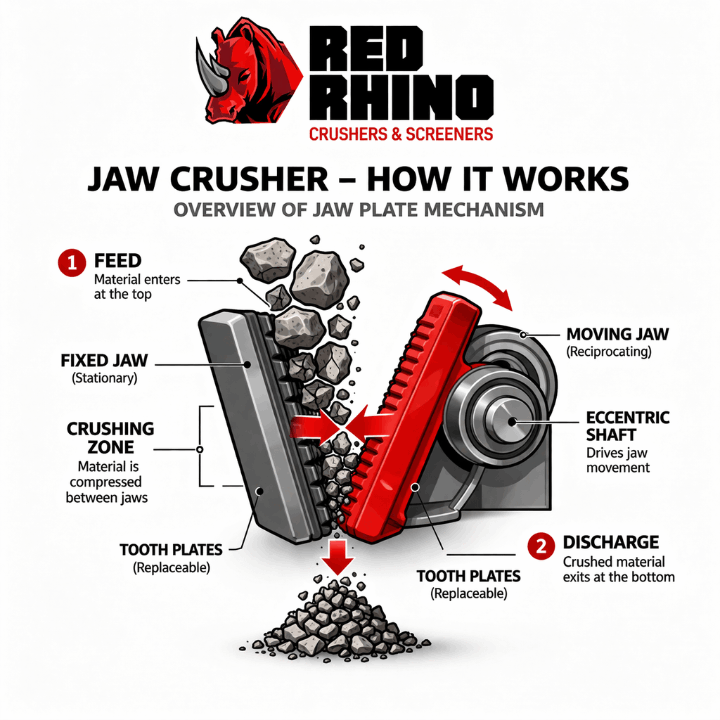
The rock drops into a V-shaped crushing chamber, where a moving jaw presses it against a fixed jaw until smaller pieces fall out at your set size. At Red Rhino, we manufacture rock crushers at our Lincolnshire, UK base, where they get distributed to sites across the world, from the northern edges of Canada to sun-soaked Australia, and all in between, including right here in Britain.
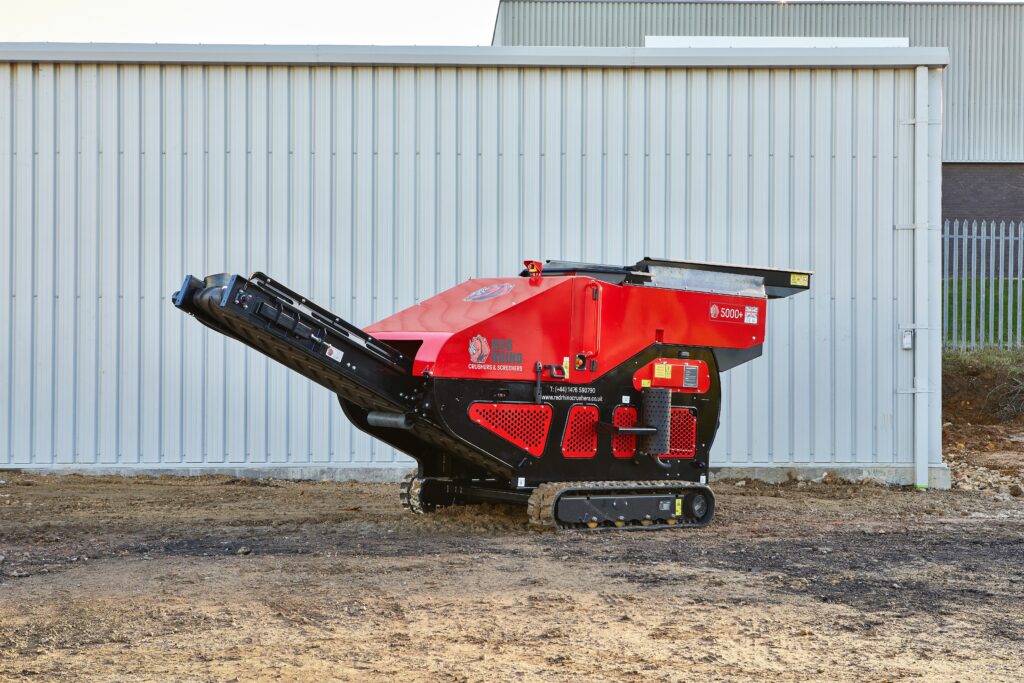
At the smaller end of our range are compact machines for tight sites and lighter jobs. At the top is our flagship RR 8000, which has an 800mm x 500mm jaw opening and can crush over 80 tonnes of material an hour depending on site conditions. The RR 5000+ and RR 7000 suit most mid-sized jobs, and there are a host of others to choose from.
It’s not just rock that our crushers are designed to process, either. Depending on the model, you can also handle concrete, brick, hardcore and mixed waste, saving you significant resources in the long run.
Looking for a rock crusher?
Whilst our crushers are designed to process a range of materials, extra care has been put into ensuring they can handle rock effectively. This is because rock is harder and denser than most demolition waste, so it needs a strong, well-built machine. We always recommend a jaw crusher specifically for rock processing.
A jaw crusher has two heavy steel plates set in a V. One stays still (the fixed jaw). The other moves, crushing whatever sits between them. Ours handle stone, dense limestone, flint, concrete, brick, block, tiles, porcelain and glass.
Other types of rock crushers, such as roll crushers and cone crushers, usually do secondary crushing or tertiary crushing in large quarries. A jaw crusher handles primary crushing, the first stage of the crushing process, taking on the big, awkward material before anything else.
You can watch the video below for an accurate demonstration.
How do jaw crushers work?
- Loading. You load the raw material into the crusher. Typically, you can use an excavator, tractor, digger, skid steer or manually with a shovel depending on the size of the crusher and the weight of the rocks.
- Crushing. A moving jaw crushes the material against a fixed jaw.
- Sizing. The material is crushed down to the output size you’ve set. Most machines adjust their output size hydraulically, from about 20mm to 120mm across the range. On the RR 8000, you can do this without stopping the machine. This creates aggregate materials that can be used for a range of purposes, such as under paving, site access, landscaping, or even sold on.
What you need to know before you buy
Specs differ by machine, so check each one against your site.
- Jaw aperture: 400mm x 170mm (RR 4000) to 800mm x 500mm (RR 8000). Your feed size must be noticeably smaller.
- Product size (the size of the rock after it’s been processed): About 20mm to 120mm, adjusted hydraulically.
- Power: Our range includes diesel and electric models.
- Dust suppression: Standard on the RR 4000, RR 5000 and RR 5000+, with fine water spray dampening the material as it’s crushed, keeping the dust down. This spray runs at ordinary domestic hose pressure.
- Controls: Many of our machines can be operated via a wireless remote handset, so one person can run the job.
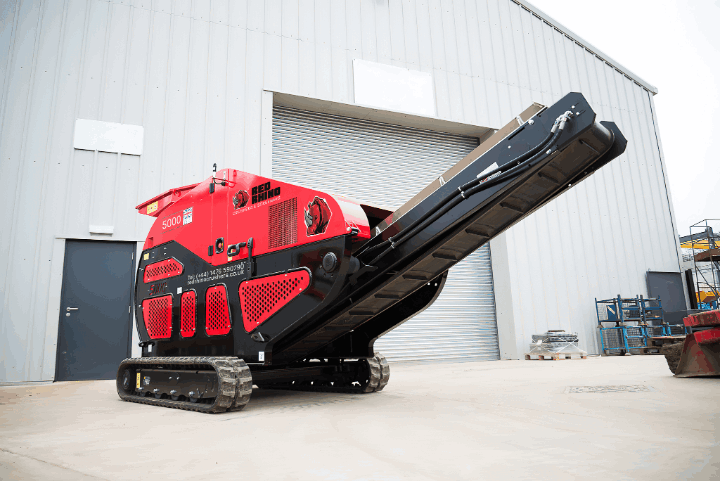
- Dimensions: Differs by product, but be sure to check the length/width/ loading height, as well as the weight. This is detailed towards the bottom of each of our product pages, with the RR 5000+ featured as an example below.
| Step | What happens | What affects it |
| Loading | Material is tipped into the crusher. Some machines use a vibrating tray that shakes material forward so it enters at a steady rate. | The size of the loading machine and how quickly material is fed in. |
| Removing small bits | Some crushers have grizzly bars (a row of spaced steel bars) that let fines drop out first. Fines are pieces already small enough not to need crushing. | Whether the crusher has grizzly bars fitted. |
| Crushing | A moving jaw squeezes the material against a fixed jaw, breaking it into smaller pieces. | The size of the jaw opening and how hard the material is. |
| Setting the size | The material is crushed until it reaches the output size the operator has chosen. | The jaw setting. A narrower setting gives smaller pieces. |
| Unloading | The crushed material leaves the machine, usually on a conveyor, and builds up into a stockpile. | How the machine is set up on site. |
In large quarries and mining operations, rock may move on to secondary crushers and a tertiary crusher, such as an impact crusher or vertical shaft impactor. These give smaller sizes and a more cubical particle shape. On most construction projects, one jaw crusher does the job.
Aside from rock, what else can a jaw crusher process?
Most hard, inert building materials become reusable aggregate.
Concrete
Slabs, kerbs and reinforced concrete make good hardcore and sub-base.
Brick and block
Old walls become crushed brick for drainage, fill or haul roads.
Mixed demolition rubble
The RR 7000 is built for it. We’d just recommend removing uncrushable objects, such as timber, plastic and loose metals, first.
Glass, porcelain and tiles
Our compact crushers turn glass and ceramics into reusable aggregate.
Stone, flint and marble
These crush into decorative or sub-base material.
What are the benefits of having a rock crusher on site?
The biggest benefits are that you stop paying to move waste off site and get plenty of aggregate to use however suits you.
Lower costs
- Skip hire: Fewer skips to fill and swap.
- Muck away: Fewer lorries hauling spoil and rubble off site.
- Landfill: Lower gate fees and landfill tax.
- Aggregate: Crushed material becomes hardcore, sub-base or backfill for the same job.
Quick set-up
On certain models, you can drive into position, set the output size and start crushing within five minutes of arriving.
Tight-site access
The RR 5000 is just 1,665mm wide, for example, establishing it as suitable for restricted access site work, and also making it easy to transport.
One-person operation
Wireless remote control lets one operator load and run the crusher. You can drive them whilst riding aboard the secure step at the rear.
Greener sites
Construction, demolition and excavation produced 66% of England’s waste in 2024, according to Defra’s UK statistics on waste (September 2026). Crushing on site recycles that material and cuts lorry movements. Our electric ES models go further, with no diesel engine at all, cutting running costs in the long run too.
What factors impact crusher performance?
A good metric for productivity in a jaw crusher is how much it can process in an hour of steady work. Here are a few factors that can influence this:
- Jaw size and crusher design: Bigger jaws can take in larger rocks, and more at once. The RR 8000 adds a deeper crushing chamber and a larger crankshaft throw.
- Feed method: A vibrating tray keeps the jaw evenly fed, and grizzly bars remove fines first.
- Type of rock: Softer materials crush faster, while abrasive rocks can slow things down.
- Jaw setting: A smaller product size means fewer tonnes per hour.
- Loader and operator: A crusher only works as fast as it is fed.
- Maintenance: Worn parts cost output. Our UK parts and servicing support keeps downtime short.
Jaw crushers: FAQs
Can a jaw crusher handle hard rock?
Yes. Jaw crushers are widely used for hard rock because they break material by squeezing it, not striking it. This keeps wear lower on dense, abrasive stone.
What is the maximum input size?
It depends on the jaw aperture, the size of the crusher’s opening. Feed material should be noticeably smaller than the opening so it enters the jaw cleanly.
What output sizes can a rock crusher produce?
Most compact jaw crushers produce pieces from around 20mm up to 100mm or more. The operator sets the output size by adjusting the gap between the jaws.
How many tonnes per hour can a rock crusher process?
Compact crushers may handle under 10 tonnes per hour, while larger machines can process 80 tonnes or more. Material type, loader size and site conditions all affect output.
Jaw rock crushers from Red Rhino
Our jaw crusher range covers everything from back-garden jobs to quarry faces.
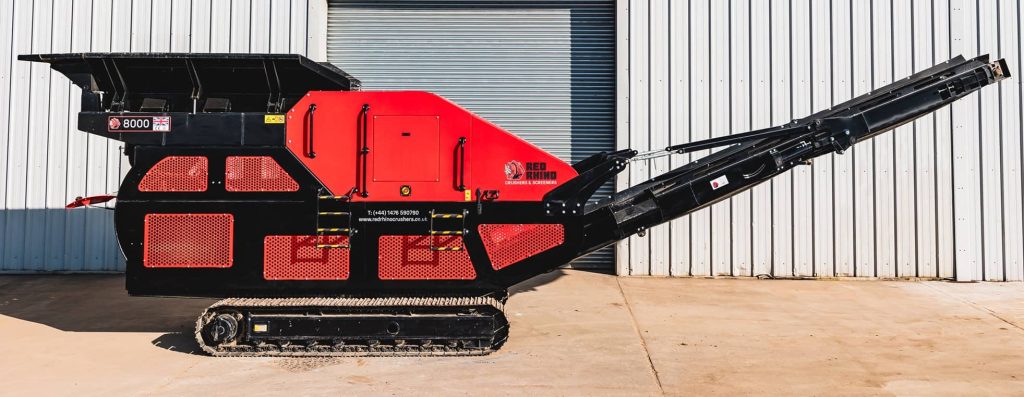
RR 8000 jaw crusher
- 800mm x 500mm jaw, over 80 tonnes per hour
- Vibrating tray, grizzly bars and a deeper crushing chamber with cast jaws
- Weighs just under 20 tonnes, jaw adjusts without stopping
- Cat 3.6 diesel engine
- Suitable for: Quarrying, hard rock and large-scale demolition
RR 7000 jaw crusher
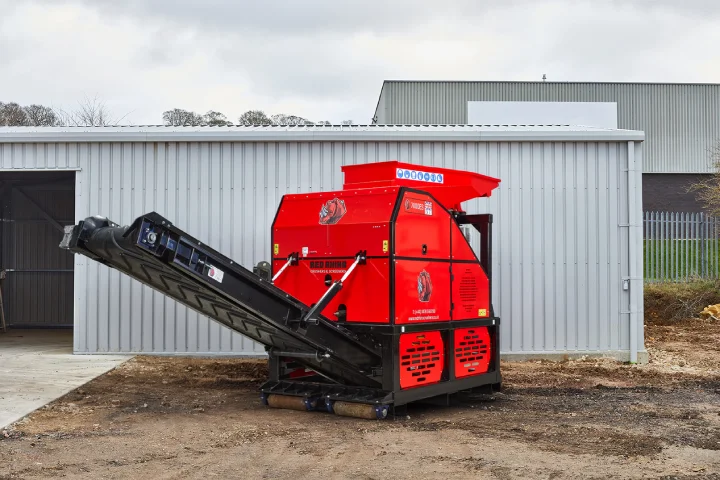
- 700mm x 400mm jaw, up to 45 tonnes per hour
- Product size up to 120mm, around 12 tonnes
- Vibratory tray, loaded by shovel or excavator
- Suitable for: Demolition recycling and larger construction projects
RR 7000ES electric static jaw crusher
- Heavy-duty electric crusher for sustained, high-volume work at a fixed location
- Suitable for: Recycling yards and long-term demolition sites
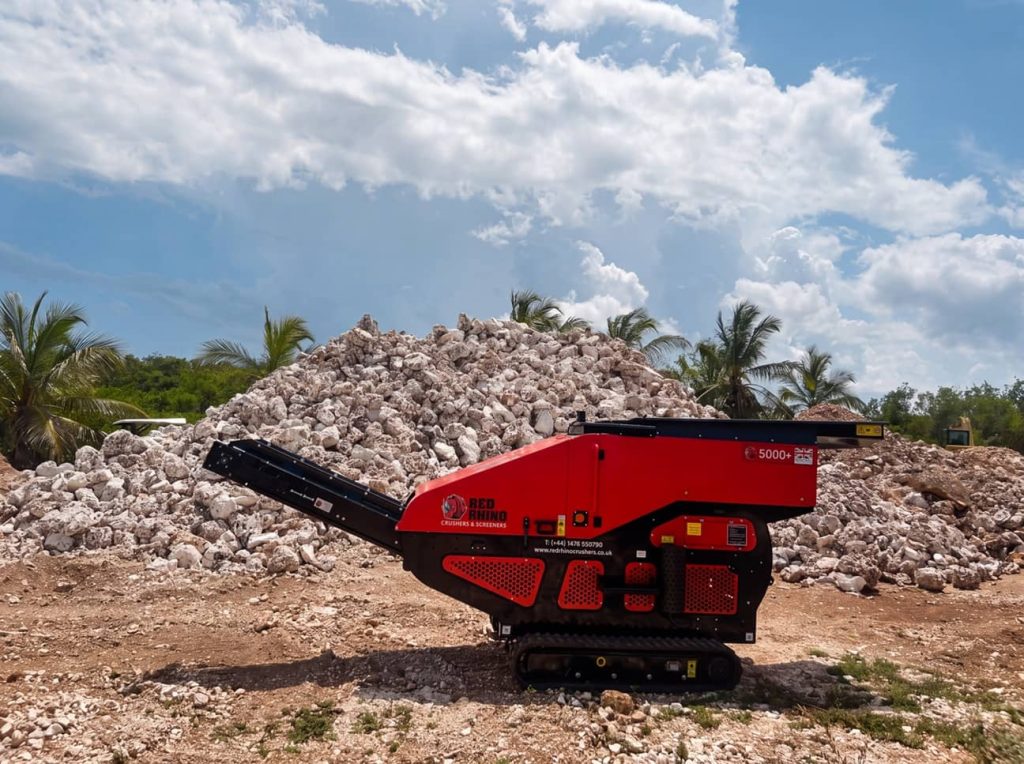
RR 5000+ jaw crusher
- 500mm x 250mm jaw with vibrating feeder and wireless remote
- Stage V Kubota 25HP engine, 1,665mm wide, dust suppression
- Suitable for: Groundworks and restricted sites; proven on dense limestone
RR 5000 jaw crusher
- 500mm x 250mm jaw; 15 to 20 tonnes per hour, 20mm to 100mm product
- Around 2.8 tonnes; 1,665mm wide, dust suppression
- Suitable for: Builders, groundworkers and hire fleets
RR 5000ES electric static jaw crusher
- Electric, with a 500mm x 250mm jaw, 20mm to 100mm, other sizes on request
- Suitable for: Fixed sites where low emissions matter
RR 4000 jaw crusher
- 400mm x 170mm jaw; 6 to 8 tonnes per hour, 20mm to 80mm product
- 1.4 tonnes, dust suppression
- Suitable for: Builders, landscapers, farmers and self-builders on tight jobs
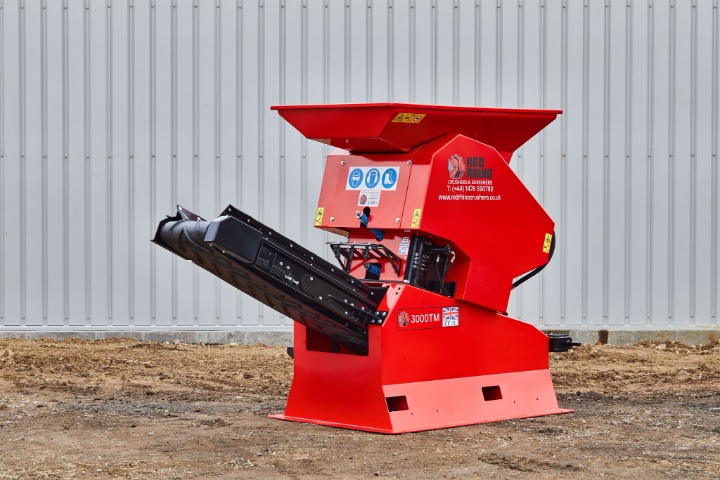
RR 3000 jaw crusher
- 500mm x 250mm jaw, 20mm to 100mm product
- Runs from a tractor’s or Bobcat’s auxiliary hydraulics
- Suitable for: Farms and smaller projects
Why trust Red Rhino Crushers?
We have built crushers in Britain for over 25 years! Here’s a bit about our background:
- Heritage: Red Rhino launched its first crushers in 1999.
- Built in Grantham: Over 45,000 sq ft of facilities, with laser cutting, CNC machining and robotic welding in-house.
- Proven worldwide: We may be renowned across the UK, but our products can also be found working from Australia and Canada to Kenya, Peru and the USA.
- Support: Flexible finance, plant hire structures and UK parts and servicing.
Find the right rock crusher for your site
Tell us what you crush, how much and where. We’ll match you with the right crusher and a tailored quote.
Call 01476 590 790 or email sales@redrhinocrushers.net to get started.